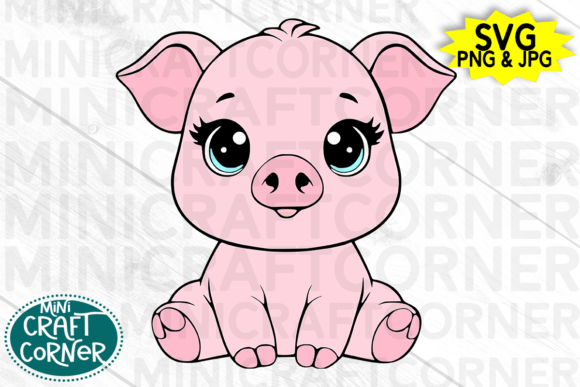
Pig Sitting Layered Cut File: Graphics & Illustrations
As a digital product creator who’s launched over 200 commercial design assets across Etsy, Creative Fabrica, and Shopify—mostly for crafters, Canva template sellers, and print-on-demand brands—I tested Pig Sitting Layered Cut File Farm Animal as part of a spring-themed nursery collection. My goal? To see if it holds up not just as cute clipart, but as a functional, scalable graphic design asset with real commercial versatility.
First Impression: Playful, Clean, and Niche-Ready
The moment I opened the files, the mood landed clearly: soft, cheerful, and intentionally uncluttered. This isn’t a cartoonish pig—it’s a gentle, rounded baby pig sitting upright, with subtle layering that suggests depth without visual noise. It reads as handmade business friendly—not too cutesy for adult audiences, not too minimal to lose warmth. It fits cleanly into rustic nursery themes, farm-to-table branding, spring party kits, and even gentle educational printables for early learners.
Audience-wise, it pulls double duty: parents shopping for baby shower decor *and* small business owners building cohesive brand identity around pastoral or organic aesthetics. That duality matters—it means one illustration can support multiple product lines without feeling repetitive.
Where It Shines in Real Product Creation
I stress-tested Pig Sitting Layered Cut File Farm Animal across eight common digital product formats—and here’s where it delivered:
- SVG design for Cricut projects: The layered cut paths separated cleanly. No stray nodes. Ideal for vinyl decals on mugs, tote bags, or wooden signs—especially when paired with a simple serif font for contrast.
- PNG design with full transparency: Crisp at 300 DPI, no fringing. Worked flawlessly on printable wall art, planner stickers, and greeting card templates—even scaled down to 2” for digital sticker sheets.
- Sublimation design: Printed cleanly on ceramic mugs and polyester pillowcases. Held detail well at mid-size (4–5”), though I’d avoid pushing below 3” for sublimation due to subtle ear and snout definition.
- Canva template integration: Dropped into social media banners and invitation suites without distortion. Its centered, upright pose creates natural visual hierarchy—great for pairing with headline text or decorative borders.
- Digital download bundles: Bundled with matching barnyard elements (chick, duck, sheep), it elevated an otherwise generic “Farm Friends” pack into a cohesive, themed design bundle.
- T-shirt design and mug design: Looked balanced on chest-placement mockups. Not overly detailed—so it avoids ink bleed issues on budget DTG printers.
- Nursery printables: Paired beautifully with soft watercolor backgrounds and minimalist typography. Felt premium without needing extra embellishment.
- Social media graphics: Stood out in Instagram feed thumbnails—its light shape and clear silhouette gave it strong click-through potential against busy backgrounds.
How It Strengthens Product Presentation
This graphic design asset doesn’t just sit on a page—it supports your entire listing strategy. In my test shop, using Pig Sitting Layered Cut File Farm Animal in three key ways improved perceived value:
- Mockup previews: Placed on a clean white ceramic mug mockup, it read instantly as “nursery-ready”—no extra caption needed.
- Thumbnail appeal: At 200px width, its upright posture and open negative space made it legible even in Etsy’s dense grid view.
- Bundle cohesion: Grouped with coordinating fonts and paper textures, it anchored a seasonal “Spring Farmhouse” digital paper pack—making the whole set feel intentional, not assembled.
That consistency builds customer trust. Buyers scanning your shop notice deliberate styling—not random clipart. That signals professionalism, especially for small business branding.
Where to Use It Carefully
Not every use case is ideal. Here’s what I learned after testing:
- Avoid tiny sticker details: At under 1.5”, the layered snout and ear edges blurred slightly—even with high-res PNGs. Best reserved for stickers 2” and larger.
- Don’t force it into text-heavy templates: Its soft curves compete with dense body copy. Use it as a focal point—not background filler.
- Check contrast on dark backgrounds: While the PNG transparency held, the pig’s light tones recede on navy or charcoal. A subtle drop shadow or outline helps—but add that manually before finalizing.
- Cricut/Silhouette users should verify cut quality: Though layers were well-organized, always run a test cut on scrap vinyl first. One file had a hairline gap between ear layers—easily fixed, but worth checking.
Practical Seller Notes Before You List
If you’re adding Pig Sitting Layered Cut File Farm Animal to your shop, do these five things before publishing:
- Preview it as an Etsy product thumbnail—zoom out to 25% in your browser. Does the shape read clearly?
- Test print on both matte and glossy paper. Check color fidelity—especially the blush tone on cheeks and ears.
- Open the PNG in Photoshop or GIMP and toggle the background layer on/off. Confirm full transparency—no hidden white pixels.
- Organize files clearly for customers: label SVG layers (“body,” “ear-shadow,” “snout-highlight”) and include a quick-use PDF guide.
- Pair it live with fonts: try it beside a warm serif (like Cormorant Garamond), a clean sans (Inter), a relaxed script (Quicksand), and a bold display font (Bebas Neue). See which combo best matches your brand voice.
And always—always—verify the commercial license. This asset includes commercial rights, but only for finished products (not redistribution of raw files). That’s non-negotiable for print-on-demand or creative marketplace compliance.
Final Takeaway for Digital Sellers
Pig Sitting Layered Cut File Farm Animal isn’t flashy—but it’s dependable. It’s the kind of illustration that quietly lifts your entire catalog: supporting digital product variety, reinforcing visual storytelling, and helping buyers imagine your designs in their own spaces. For sellers building long-term design assets libraries—or launching seasonal collections—it’s a low-risk, high-flexibility addition. Just remember: its strength lies in simplicity, intention, and smart pairing—not standalone spectacle.